What it was
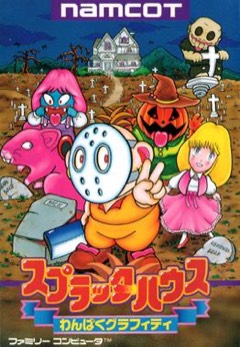
Splatterhouse was Namco's blood-soaked 1988 arcade beat 'em up. Its first home-console follow-up went the other way entirely: big heads, tiny bodies, and a run of horror-film parodies played for laughs. Wanpaku Graffiti opens in a graveyard, with Jennifer weeping over Rick's grave. Lightning brings Rick back, mask and all. A second bolt wakes the Pumpkin King in the grave next door, and he promptly carries Jennifer off.
Where the arcade game is about punching, this one is a platformer. Rick swings an axe and, in some stages, picks up a shotgun with limited shells. Beat enough enemies and his health bar grows, with a counter at the top of the screen showing how many more you need. A four-digit password takes you back to later stages, a first for the series. Find two hidden crystal balls and the ending adds an epilogue that ties the story to the original game.
Where it sits in history
Now Production developed it and Namco published it for the Famicom in Japan in July 1989. It is the second Splatterhouse game and the first made for a home console. Then it stayed in Japan for more than thirty years. Its first official release in the West came on 18 June 2020, when Bandai Namco put a localised version in Namco Museum Archives Vol. 1, a collection of Namco's Famicom and NES games built by the re-release specialist M2 for Nintendo Switch, PlayStation 4, Xbox One and PC via Steam.
Reviewers of that collection picked it out as a highlight, and earlier write-ups had already praised its graphics, its controls and the parody itself. The ending is the best gag in it. The whole adventure turns out to be a film shoot: a director thanks Rick for his performance, Rick takes off the mask, and everyone heads home. Then, with the set empty, the mask starts to move.
How it plays today
The charm holds up. The super-deformed sprites are full of personality, the monsters are affectionate send-ups of horror-film favourites, and the tone sits closer to a Saturday morning cartoon than a slasher. The axe and the growing health bar give each stage a small sense of progress.
The platforming is solid rather than special, and anyone hoping for the arcade game's gore will not find it here; this is horror as a costume party. On those terms it is one of the more likeable oddities on the Famicom, and thanks to the Archives release it is finally easy to play in English, with save states and a rewind to smooth out any rough spots.
Compared with
Why it matters
The last scene is the whole game in miniature. Rick finishes the shoot, takes off the mask and walks away as himself. Then the mask, left alone, comes to life.
Roger Caillois counted mimicry, make-believe, among the four basic kinds of play: the pleasure of being someone else for a while. Nick Yee and Jeremy Bailenson found a sharper edge to it, the Proteus effect: people's behaviour shifts to match the avatar they are given. Put on the costume and you start to act the part. Wanpaku Graffiti plays both sides. It is a game about dressing up, a horror hero squeezed into a cartoon body, a film set with a director waiting to call cut. And its final sting is a joke about what the mask keeps after you take it off. Anyone who has spent an afternoon as someone braver, stronger or stranger knows the feeling of walking back into the lounge room slightly changed. The mask does not really come alive. We carry a bit of it out with us.
Read: Who you are when you play →
- Caillois, R. (1958/1961). Man, Play and Games (trans. M. Barash).
- Yee, N., & Bailenson, J. (2007). The Proteus effect: The effect of transformed self-representation on behavior. Human Communication Research, 33(3), 271-290. doi:10.1111/j.1468-2958.2007.00299.x
Verdict · 7/10
A cheerful horror parody that swaps the arcade game's gore for jokes and mostly gets away with it. A modest platformer with a great ending, now playable in English.