What it was
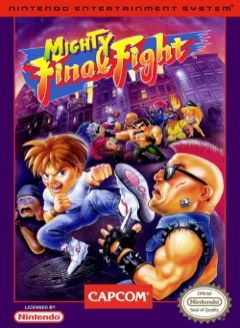
Mayor Haggar's daughter, Jessica, has been kidnapped by the Mad Gear gang, and this time their boss, Belger, wants to marry her. The heroes who go after her are drawn as big-headed, childlike versions of themselves. Mighty Final Fight is Capcom's comic NES retelling of its 1989 arcade brawler Final Fight, and it is a good deal funnier than the original.
You pick one of three fighters: Cody, a street brawler who mixes karate and boxing; Guy, a ninjutsu master; or Haggar, a former professional wrestler. Only one person can play, unlike the arcade game, but all three characters are on the cartridge, unlike Capcom's SNES ports. Each keeps almost all of their arcade moves and has a signature weapon: a knife for Cody, shuriken for Guy and an oversized mallet for Haggar. Five stages and two bonus rounds lead to the final boss, a cyborg Belger.
Where it sits in history
Capcom released it in 1993, in Japan in June and later that year in North America and Europe. Its best idea came from the Famicom version of Technos Japan's Double Dragon: experience points. Defeat an enemy and you earn points, with more for finishing them with a stronger move. Each level raises your attack power and maximum health, across six in total. Cody and Guy start at level one, Haggar at level three, and at level four each learns a new special: Cody's Tornado Sweep projectile, Guy's Tornado Kick and Haggar's Running Clothesline.
It returned in 2006 in Capcom Classics Mini-Mix for the Game Boy Advance. Allgame's Christian Huey called it a guilty pleasure, and in 2013 Arcade Sushi ranked it sixth among the best retro beat 'em ups.
How it plays today
The art is the draw. The super-deformed sprites are big, bright and full of character, and the retold story leans into its jokes. The levelling system gives you a reason to finish enemies with style instead of mashing, and reaching level four and seeing Haggar's clothesline for the first time is a real treat.
It is short, at five stages, and the loss of the arcade game's second player hurts: beat 'em ups are better with a friend on the couch, and Final Fight more than most. Still, as a single-player NES brawler it is one of the more polished, and having all three fighters on one cartridge gives it more reasons to replay than you might expect.
Compared with
- Final Fight: The SNES port of the arcade original: bigger, grittier and one fighter short.
- Double Dragon: The Famicom brawler whose experience points system Mighty Final Fight borrowed.
- River City Ransom: Another NES brawler about growing stronger as you fight, with an open city and a second player.
Why it matters
Final Fight is a street brawl in a grim city. Mighty Final Fight is the same story acted out by what look like kids in a schoolyard: big heads, round cheeks, and a villain who wants to marry the mayor's daughter. The punches still land, but the whole thing reads as play-fighting rather than violence.
Jaak Panksepp and Jeff Burgdorf found that rats make ultrasonic 'laughter' when tickled and go looking for play: play and joy run deep in mammals, far older than cities or cartridges. Johan Huizinga made the same point from the other direction, arguing that play is older than culture itself. Watch puppies tumble or two kids wrestle on a trampoline and the rough stuff is plainly a game, with rules nobody wrote down. Capcom seems to have understood that. Take the grit out of a beat 'em up, draw everyone as children, and what remains is one of the oldest games we have: pretending to fight, and laughing while we do it.
Read: Older than us: play before people →
- Panksepp, J., & Burgdorf, J. (2003). 'Laughing' rats and the evolutionary antecedents of human joy? Physiology & Behavior, 79(3), 533-547. doi:10.1016/S0031-9384(03)00159-8
- Huizinga, J. (1938/1949). Homo Ludens: A Study of the Play-Element in Culture.
Verdict · 7/10
A cheerful, well-made NES brawler that turns Final Fight into a cartoon and adds a clever levelling system. Short and single-player only, but easy to enjoy.