What it was
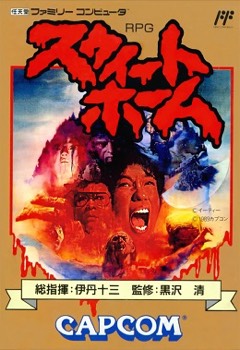
Five documentary filmmakers walk into an abandoned mansion to find frescos that the painter Ichirō Mamiya hid there before he vanished thirty years earlier. The door shuts behind them, a ghost warns that trespassers die, and the house begins to come apart around them. Sweet Home is a role-playing game, but it spends its time on what horror needs: scarce supplies, a house you slowly learn, and people you can lose.
You split the five into teams of two or three and switch between them whenever you like. Each carries a tool nobody else has, a camera, a lighter, a medical kit, a lockpick or a vacuum cleaner, and each tool opens a different part of the house. Anything else can be put down anywhere for someone else to collect later. Monsters, from zombies to ghosts to dolls, ambush you at random in first-person menu battles, and the only healing comes from tonics left around the rooms. Some traps demand a quick decision or kill you on the spot. When someone dies they stay dead, and the story carries on without them. How many survive decides which of five endings you see.
Where it sits in history
Capcom made it alongside the Japanese horror film of the same name. Tokuro Fujiwara, who had directed Ghosts 'n Goblins, directed the game. Juzo Itami, the film's executive producer, produced it, and the film's director, Kiyoshi Kurosawa, supervised and told Fujiwara not to worry about following the movie exactly. The game's plot drifts from the film's as a result. Fujiwara had worked mostly in arcades until then and at times found the Famicom's graphics a frustration.
It came out in Japan on 15 December 1989 and nowhere else. Famitsu's reviewers praised its atmosphere and gave it a critics' choice award that year, and several critics rated it above the film. Its gruesome imagery, and the low standing of role-playing games in the West, probably kept it from being translated. Fans finished an English translation in 2000.
Its real legacy arrived in 1996. Capcom's Resident Evil, directed by Shinji Mikami with Fujiwara producing, took Sweet Home as its main inspiration. Capcom no longer held the film licence, so it built a new world, but the tangled mansion, the scattered notes, the tight inventory, the lockpick and lighter, and endings that turn on who survives all made the trip.
How it plays today
It is genuinely unsettling for an 8-bit game. The mansion feels planned rather than stitched together, and notes and diaries left by earlier visitors do a lot with very little text. Losing a character stings, because their tool goes with them, and although the game leaves a substitute near the body, it never feels like a fair trade.
It is also a Famicom role-playing game, with random battles and menus that slow the pace, and backtracking that can test your patience. The original is in Japanese only. Come to it expecting a horror adventure on RPG bones, not a modern survival horror game, and it holds its grip remarkably well.
Compared with
- Ghosts 'n Goblins: Fujiwara's earlier horror, played as arcade action: harder on the hands, much lighter on dread.
- Castlevania II: Simon's Quest: Another late-1980s attempt at horror you explore rather than just survive, with far more combat.
- Mother: Another Famicom role-playing game set in a modern world rather than a fantasy one, and far gentler.
Why it matters
Sweet Home asks you to care about five people and then lets the house take them. A dead character stays dead, and the ending depends on who you kept alive. It is a game about fear and loss, on a console sold as a family toy.
Johan Huizinga described play as set apart from ordinary life, inside a 'magic circle' with its own order, freely entered and bounded. That boundary is what makes horror playable at all. Inside the circle we can walk into a family tragedy, lose a friend to a trap and feel real dread, because we chose to step in and we can step back out. Sweet Home keeps its circle carefully. Its rules are clear, its supplies are scarce and its house follows its own logic, so the fear feels earned rather than random. People have always told ghost stories in the dark for the same reason: to be afraid together, safely, and then to turn the lights back on.
Read: The magic circle: the world that rules make →
- Huizinga, J. (1938/1949). Homo Ludens: A Study of the Play-Element in Culture.
Verdict · 8/10
The Famicom's most frightening game and the blueprint for Resident Evil, held back only by the RPG pacing of its day. Worth the effort for anyone who loves horror or wants to see where survival horror began.