What it was
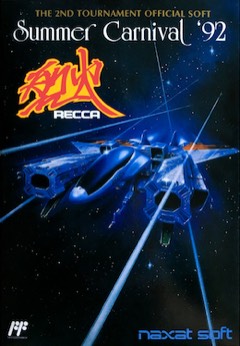
Recca looks like it should not run on a Famicom. Enemies pour in, bullets fill the screen, and the whole thing moves at a speed the console was never meant to manage. You fly the Recca415 fighter in the year 2302, against an alien armada that has already wiped out the Andromeda galaxy and now means to finish off humanity.
Across four stages you collect five main weapons, plus sub-weapons that add two satellite options firing in several directions. The clever part is the shield. Stop firing for a moment and a charge builds in front of the ship, strong enough to soak up ordinary enemy shots, then let it go as a blast that wipes out anything nearby. A hit costs a life and resets your firepower. Clear the game and a harder second loop of seven rearranged stages opens. Score Attack gives you two minutes to rack up points, Time Attack asks you to clear two stages as fast as you can within five, and a hidden Zanki Attack mode hands you fifty lives but makes every destroyed enemy fire back.
Where it sits in history
KID, a contract developer, made it for Summer Carnival, a shooting game competition Naxat Soft held on 17 July 1992, where it shared the bill with the PC Engine CD-ROM² shooter Alzadick. It went on sale in shops the same day. Shinobu Yagawa programmed it and later made Battle Garegga and other shooters at Raizing and Cave. Nobuyuki Shioda wrote the dark techno score, turning down the Famicom's two square-wave channels so the low triangle-wave sounds could come through. Like Contra, it draws explosions and other effects at 30 frames per second instead of 60 to get around the console's sprite limits.
It arrived when attention had moved to the Super Famicom and sold few copies, which is why it is now one of the rarest and most expensive Famicom games. Readers of Family Computer Magazine were lukewarm, scoring it 16.8 out of 30, and Famitsu's reviewers warned it was too much for beginners. Critics since have been kinder, and USgamer's Jeremy Parish counts it as a forerunner of modern bullet hell shooters. Its 3DS Virtual Console release in 2012 and 2013 was its first outside Japan.
How it plays today
It is thrilling. The speed and density feel years ahead of their time, the charge shield adds a real risk-and-reward decision to every wave, and the soundtrack pounds. Score Attack and Time Attack suit short sessions and make it a game you keep coming back to.
It is also hard, busy and flickery. The Famicom strains under this many objects, and a bullet can be hard to pick out of the chaos. Four stages pass quickly, and newcomers will run out of lives long before they learn the patterns. For fans of the genre none of that matters much. The bigger obstacle is price: an original cartridge now costs serious money.
Compared with
- Crisis Force: Konami's Famicom shooter, another late showpiece that pushes the hardware hard.
- Gun-Nac: Compile's colourful NES shooter; busy and fast, but far friendlier to newcomers.
- Zanac: Compile's earlier NES shooter, fast for its day and a clear ancestor of this kind of game.
Why it matters
Recca was built for a competition, and it shows. The main game is short and hard. The extra modes are harder still: two minutes for a score, five for a time, and a secret mode that gives you fifty lives because you will need most of them.
Jesper Juul calls it the paradox of failure: we avoid failing in life, yet seek it out in games, because failure makes us reconsider and improve. Recca is that paradox with a techno soundtrack. Nobody clears it the first time. You die to a bullet you never saw, restart, and the second time you see it. Then you learn to hold your fire and let the shield charge, trading safety for power. A game this fast shrinks failure down to seconds, and every restart is a small lesson. In Zanki Attack even your successes fire back at you. Fifty lives is not generosity. It is an invitation to fail forty-nine times on the way to getting good.
Read: One must imagine Mario happy →
- Juul, J. (2013). The Art of Failure: An Essay on the Pain of Playing Video Games. MIT Press.
Verdict · 8/10
One of the fastest, most technically daring games on the Famicom, and a real forerunner of bullet hell. Brutal and flickery, but exhilarating.