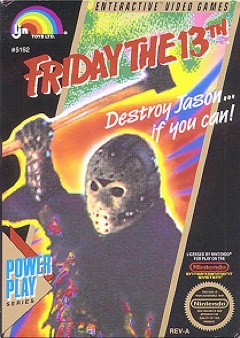
What it was
Six camp counsellors, a lake, a scatter of cabins and Jason Voorhees. Your job is to last three days and three nights at Camp Crystal Lake and to find and defeat Jason three times before he kills the children in your care, or the counsellors themselves.
You control one counsellor at a time along side-scrolling paths through woods, caves and past the lake, throwing rocks at zombies, crows and wolves. Each counsellor runs, jumps, throws and rows differently, and better weapons turn up as you explore. Every so often an alarm sounds: Jason is attacking someone, and a clock starts. Use the map to get there in time, or switch to the counsellor under attack, or someone dies. Inside a cabin the view changes and Jason comes at you head-on, in a fight that recalls Punch-Out!!. Light the fireplaces in the big cabins to earn a flashlight and a torch, follow notes to new items, and you can even find Jason's mother, a floating head, behind a locked door in the cave.
Where it sits in history
Atlus developed it for LJN, which published it only in North America in February 1989 as part of a push into games based on film and TV licences. Atlus founder Hideyuki Yokoyama supervised. Ryutaro Ito, later a planner on the Shin Megami Tensei series, tested it and remembered how hard it was to make any progress; he put that down to a habit among some publishers of making NES games for the US very difficult. Jason's purple and blue outfit may come from a Japanese poster for Friday the 13th Part III that shows him lit in blue.
The reviews were harsh and stayed harsh. GamePro listed it as the tenth-worst game based on a film. In 1997 Electronic Gaming Monthly ranked it the eighth-worst console game ever, and Nintendo Power named it the sixth-worst game ever made. Game Informer lists it among the hardest horror games of all time. Yet it never quite went away. In 2013 a collectibles company released a figure of the game's purple Jason, and in 2017 the makers of Friday the 13th: The Game added a Retro Jason skin based on it, as an apology to fans for that game's troubled launch.
How it plays today
There is a good idea at its core: a map, a clock and a killer who can strike anywhere, so every decision is about where to be. That idea deserved a better game.
In practice the woods and caves are built to disorient, the paths repeat, and the rock-throwing combat is weak. Jason's attacks tend to come while you are far away and lost, the music loops relentlessly, and losing everyone ends the game. It rarely frightens and often frustrates. Play it with a friend and a hand-drawn map, for the laughs and the history, and stop when it stops being funny.
Compared with
- A Nightmare on Elm Street: LJN's other horror licence on the NES; a figure of its Freddy Krueger stood beside the purple Jason.
- Sweet Home: The same year, on the Famicom, Capcom showed what an 8-bit horror game could really do.
Why it matters
By almost every measure, Friday the 13th failed. Critics called it one of the worst games ever made and kept saying so for years. Yet in 2017, when the makers of a new Friday the 13th game wanted to say sorry to their fans, they did it with this game's purple Jason.
Tim Wildschut and colleagues found nostalgia is mostly positive, often features close others, and raises social connectedness and self-regard. That explains the odd afterlife of a bad game. What people remember is rarely the lost counsellors or the loops through the woods. It is the rental on a Friday night, yelling at the screen with a friend, getting lost together and laughing about it at school on Monday. The memory is warm even when the game was not, because the memory is mostly about who was there. A purple Jason became a shared joke, and a shared joke is a kind of home.
Read: Why old games feel like home →
- Wildschut, T., Sedikides, C., Arndt, J., & Routledge, C. (2006). Nostalgia: Content, triggers, functions. Journal of Personality and Social Psychology, 91(5), 975-993. doi:10.1037/0022-3514.91.5.975
Verdict · 3/10
A good premise buried under confusing maps, weak combat and constant frustration. Worth a look as a piece of NES folklore, not as a game to finish.