What it was
Everything starts with a small brown mushroom walking left while Mario walks right. What follows is 32 stages across eight worlds, a princess held by King Koopa, now better known as Bowser, and a Toad at the end of each of the first seven castles with bad news about her whereabouts. Nobody reads a manual to learn it. World 1-1 hands you a Goomba, a question block and a mushroom that is hard to dodge, and by the first pipe you know how the game works.
The toolkit is small and exact. A Super Mushroom doubles Mario's size and lets him smash bricks. A Fire Flower adds fireballs. A Starman makes him briefly untouchable. Kicked Koopa shells become weapons that can bounce off a wall and hit you on the way back. A hundred coins earn an extra life, pipes hide bonus rooms, and warp zones skip whole worlds. Finish once and a harder second quest swaps every Goomba for a Buzzy Beetle, which shrugs off fireballs. A second player can join as Luigi.
Where it sits in history
Shigeru Miyamoto and Takashi Tezuka designed it at Nintendo, Toshihiko Nakago of SRD wrote most of the code, and Koji Kondo composed the score and every sound effect. It borrowed the scrolling engine from Excitebike, which is why Mario builds from a walk to a run instead of moving at one speed. Everything had to fit in 32 kilobytes of program and 8 of graphics. The bushes are recoloured clouds, the Goomba walks by flipping a single image, and with about 20 bytes left the team added a crown that shows in your life counter once you reach ten lives.
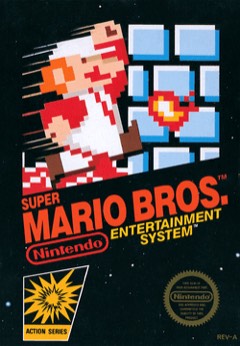
It came out on the Famicom in Japan on 13 September 1985 and reached North America on the NES later that year, though the exact date is still argued over. Europe waited until 15 May 1987. Many Western players met it first in arcades, through the tougher VS. Super Mario Bros. From 1988 it shared a cartridge with Duck Hunt as the pack-in for the NES Action Set. Not counting re-releases, the NES game sold 40.24 million copies, and it stayed the best-selling game of all time for more than 20 years.
How it plays today
The controls are why it lasts. How high and how far Mario jumps depends on how long you hold the button and how fast you are running, and forty years on that still feels right in the hands. The level design teaches without a word, secrets reward curiosity, and the overworld theme is still one of the most recognisable tunes in games.
Age shows at the edges. Run out of lives and you start again at 1-1, unless you know to hold A on the game over screen to restart from the current world. World 4-4 loops until you find the right path, and the later worlds lean hard on tight jumps over pits. None of that spoils it. A full run takes an evening, and the best players on earth now finish in under five minutes.
Compared with
- Super Mario Bros. 3: The NES sequel that grew the formula into world maps, suits and far more ideas per stage.
- Excitebike: Mario's run came from this game's scrolling engine, and you can feel the family resemblance.
- Super Mario All-Stars: The 1993 SNES remake: the same levels with 16-bit graphics and saving.
Why it matters
In 2021 a speedrunner called Niftski became the first to finish Super Mario Bros. in under 4 minutes 55 seconds. The record now stands at 4:54.332, just 67 milliseconds off the best time thought humanly possible. Thousands of hours of practice, spent on a gap shorter than a blink.
Bernard Suits defined playing a game as 'the voluntary attempt to overcome unnecessary obstacles', and speedrunners have taken him at his word: the obstacle is now the clock, and nobody asked them to beat it. Mihaly Csikszentmihalyi's work on flow explains why they keep going. Absorption arrives when challenge matches skill, the goal is clear and feedback is immediate; self-consciousness fades and time bends. Super Mario Bros. offers all of that from the first Goomba. The goal is always to the right. Every jump tells you at once whether it worked. And as your skill grows, the game grows with you, from finishing at all, to finding the warp zones, to shaving frames. A kid in 1985 and a record holder today chase the same feeling through the same 32 stages.
If you still own the cartridge but not the console, MyNESGames plays the NES games you own in a browser, with save states and a gamepad or touch controls.
Read: The zone: why good games make time disappear →
- Suits, B. (1978). The Grasshopper: Games, Life and Utopia.
- Csikszentmihalyi, M. (1990). Flow: The Psychology of Optimal Experience.
Verdict · 9/10
The template for the side-scrolling platformer, and still one of the best-feeling games Nintendo ever made. Start here, then play everything it inspired.